A common question for those new to Pilates is what is the difference between mat and Reformer Pilates. Mat Pilates is great for accessibility as all you need is, as the name implies, a mat — and possibly a few bits of equipment such as a Pilates ball. Mat Pilates uses your body weight for resistance and the basic exercises improve abdominal strength, posture and balance. While spine and joint mobility exercises are a good way of easing ailments like back pain.
Pilates for Beginners
Mat Pilates for beginners is a good affordable introduction to the principles and language of Pilates, plus the importance of breath work. All you need is to be able to lie down on a mat and have enough space to move your legs and arms. It can be a good way of following up Reformer classes with exercises at home in a confined space. One misconception is that mat is easier than Reformer Pilates. It isn’t, as working against gravity is challenging and some exercises can actually be easier on a Reformer.
Reformer Machines
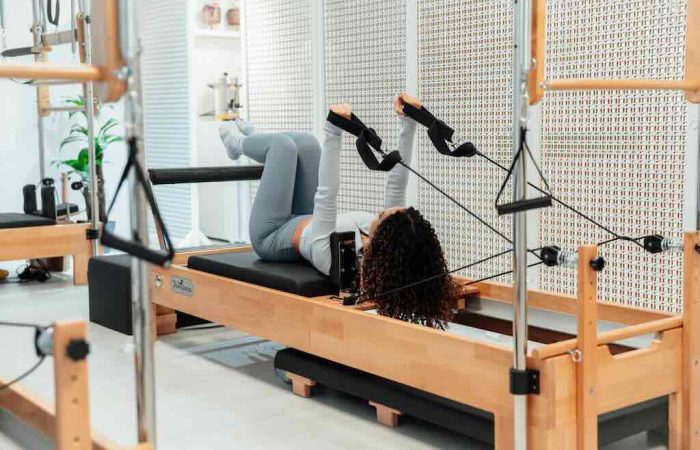
With Reformer Pilates a Reformer machine has a sliding platform known as a carriage, attached to a metal frame with springs. It has pulleys, straps and bars to assist with various exercises. The Reformer can look intimidating at first but with the right instruction you’ll soon be at ease. It is said that the earliest version of a bed with springs, the Cadillac, was improvised by Joseph Pilates using hospital beds and springs when he was treating patients at the Knockaloe internment camp on the Isle of Man during the first world war. The Reformer was fully developed when Pilates opened his studio in New York in the late 1920s.
Specific Muscle Groups
Today’s versions are of course a lot more sophisticated. The moving carriage and springs and straps on the Reformer can be used to provide resistance or assistance to movement. So exercises can be made either harder or easier at the discretion of your teacher. Reformer Pilates is a good way to target specific muscle groups and work on particular areas of the body. Its challenging exercises should improve posture, strength, flexibility and functional movement.
If you are easily bored then Reformer Pilates will provide a lot more positions than mat Pilates. You might be standing, sitting, kneeling, lying on your back or stomach or on your side. The Reformer is also an excellent device for working on specific areas for sports; say improving strength and rotation for a golf swing, jumping ability as testified by football’s Ronaldo, explosive movements for tennis or core muscles and balance for paddleboarding.
Rehabilitation
The Reformer can be very useful for rehabilitation work as it is so versatile. For example there are exercises where you can use your body and arms but not put weight on an injured foot. Many ballet dancers used the Reformer at Joseph Pilates’ New York studio and it remains very useful to injured dancers. Some of the basic moves on the Reformer replicate the actions that are used as part of dancers’ daily exercise. Some dancers still refer to it by its more informal name of the “Plie” machine, which is French for “to bend”.
Though it’s certainly not a case of either one or the other types of Pilates. Reformer Pilates can be a targeted high-intensity workout with lots of variety, but it should be remembered that both mat and Reformer Pilates were originally designed to be used together. With the help of our teachers at Pilates Central both will improve your strength and flexibility. Happy exercising.
If you would like our newsletter you can subscribe on the Home page. Follow us on social media:
Facebook | Instagram | X | Linkedin.
The Pilates Central Team