Those new to Pilates often ask if Pilates can replace the gym. That all depends on your fitness goals, though the two don’t have to be in opposition. It’s certainly a myth that Pilates is somehow an easy form of exercise. Social media is currently full of viral videos of football teams and “gym bros” trying out Pilates thinking it will be easy and then ending up moaning and groaning and with the “Pilates shakes”. It’s important to remember that Pilates is not a competition, you are concentrating on slow controlled movements rather than trying to out-lift or out-pull anyone else.
Functional Strength
Pilates builds what is termed functional strength, the type of strength you can use in everyday activities. It takes the body as a whole and engages multiple muscle groups, so the result should be better stability, balance and co-ordination in day-to-day life. Functional Pilates should result in fewer injuries and can be adapted around activities ranging from desk work to carrying shopping or rock climbing. Strength is built through precision and controlled movement against the resistance of the Reformer or in mat Pilates gravity, rather than through lifting heavy weights.
Build Muscle with Pilates
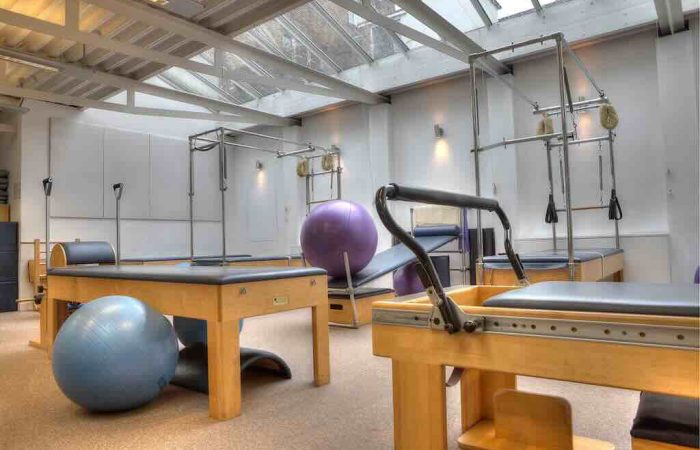
Contrary to what some gym users believe you can indeed build muscle with Pilates. You can increase the spring weight on a Reformer and change the level or shorten ropes to challenge muscle groups and improve muscle tone. Pilates looks at the body as an integrated system and both mat and Reformer Pilates will work your core muscles, glutes, legs, arms and backs in integrated movements. It can improve bone density and will build endurance and stability in a way that gym work might not.
“Fitness Dude”
Another misconception among gym users can be that Pilates is only for women. Joseph Pilates developed his exercises in a New York gymnasium and he was the ultimate “fitness dude” or “gym bro” as well as being a boxer and circus strongman. His exercises require strength and endurance.
Of course, if you are body building or want to really put on muscle then gym work might be best, but most people have more modest goals. While the resistance can be increased on a Reformer there is a maximum limit. Pilates will not massively bulk up muscles, but will give you lean muscle tone and more endurance and energy.
A Complement to Gym Work
Pilates can also be a very useful complement to gym work. Gym work will build your major muscles, but this does not guarantee you will have control over the smaller stabilising muscles. Pilates will help by working on all muscles, particularly those in your core. Learning slow controlled movements that stabilise the body will help avoid injury when doing more explosive movements in weightlifting.
Better flexibility and balance will also benefit gym users while Pilates will be kinder to the joints than gym work as it is low-impact and a good alternative to constant high-impact work. Learning the breathing techniques of Pilates will certainly enhance your movements when weight training and make exercise less stressful.
Conclusion
To conclude Pilates is a form of strength training just like gym work, but with a different philosophy of building a functional balanced body. It can be used alongside gym work or as an alternative to pumping iron. There is no “correct” form of exercise, but whatever your goals, Pilates should enhance your routine and boost your body.
If you would like our newsletter you can subscribe on the Home page. Follow us on social media:
Facebook | Instagram | X | Linkedin.
[image credit: Meng Tang, pixabay)