Welcome to the May edition of Pilates Central News.
In this edition:
- Can Pilates replace the gym?
- Boombastic Pilates
- Over the moon
- Alpaca Pilates
Can Pilates replace the gym?
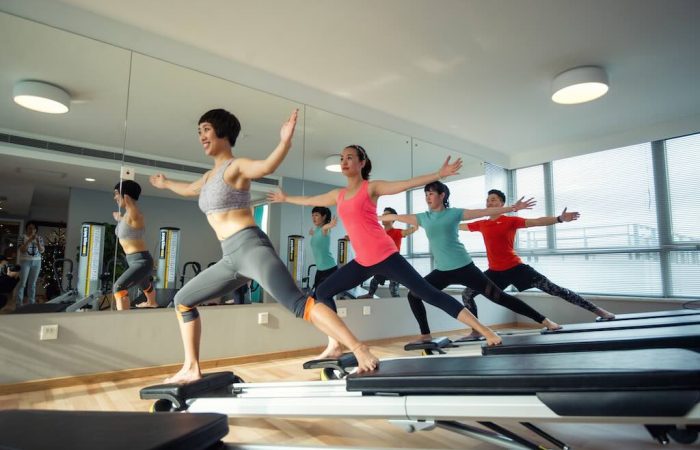
Those new to Pilates often ask if Pilates can replace the gym. That all depends on your fitness goals, though the two don’t have to be in opposition. It’s certainly a myth that Pilates is somehow an easy form of exercise. Social media is currently full of viral videos of football teams and “gym bros” trying out Pilates thinking it will be easy and then ending up moaning and groaning and with the “Pilates shakes”. It’s important to remember that Pilates is not a competition, you are concentrating on slow controlled movements rather than trying to out-lift or out-pull anyone else.
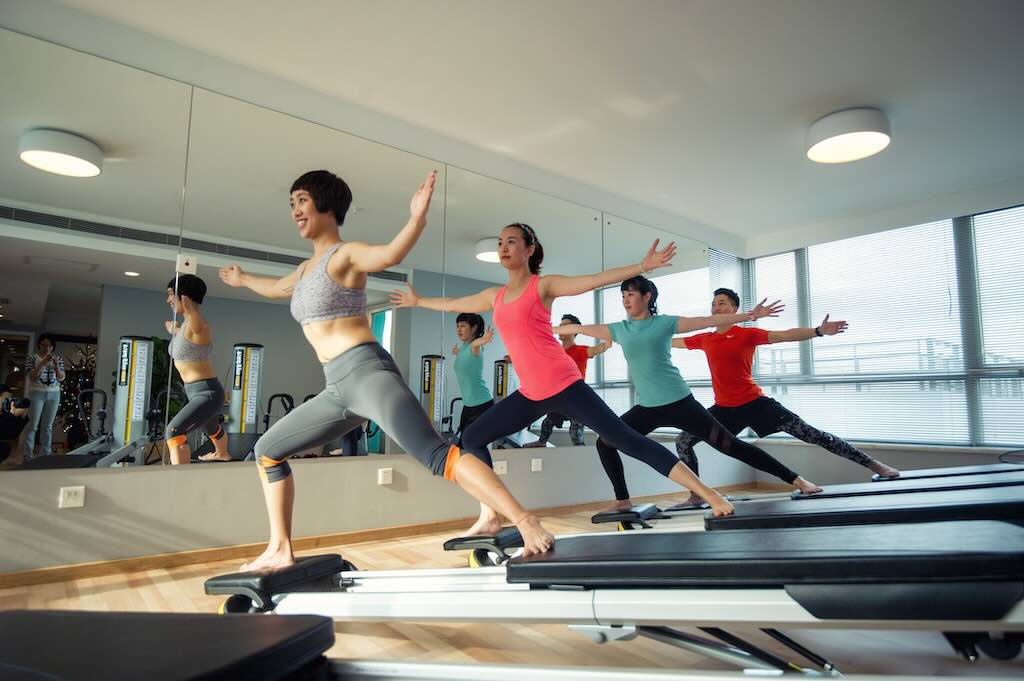
Pilates builds what is termed functional strength, the type of strength you can use in everyday activities. It takes the body as a whole and engages multiple muscle groups, so the result should be better stability, balance and co-ordination in day-to-day life. Functional Pilates should result in fewer injuries and can be adapted around activities ranging from desk work to carrying shopping or rock climbing. Strength is built through precision and controlled movement against the resistance of the Reformer or in mat Pilates gravity, rather than through lifting heavy weights.
Contrary to what some gym users believe you can indeed build muscle with Pilates. You can increase the spring weight on a Reformer and change the level or shorten ropes to challenge muscle groups and improve muscle tone. Pilates looks at the body as an integrated system and both mat and Reformer Pilates will work your core muscles, glutes, legs, arms and backs in integrated movements. It can improve bone density and will build endurance and stability in a way that gym work might not.
Another misconception among gym users can be that Pilates is only for women. Joseph Pilates developed his exercises in a New York gymnasium and he was the ultimate “fitness dude” or “gym bro” as well as being a boxer and circus strongman. His exercises require strength and endurance.
Of course, if you are body building or want to really put on muscle then gym work might be best, but most people have more modest goals. While the resistance can be increased on a Reformer there is a maximum limit. Pilates will not massively bulk up muscles, but will give you lean muscle tone and more endurance and energy.
Pilates can also be a very useful compliment to gym work. Gym work will build your major muscles, but this does not guarantee you will have control over the smaller stabilising muscles. Pilates will help by working on all muscles, particularly those in your core. Learning slow controlled movements that stabilise the body will help avoid injury when doing more explosive movements in weightlifting.
Better flexibility and balance will also benefit gym users while Pilates will be kinder to the joints than gym work as it is low-impact and a good alternative to constant high-impact work. Learning the breathing techniques of Pilates will certainly enhance your movements when weight training and make exercise less stressful.
To conclude Pilates is a form of strength training just like gym work, but with a different philosophy of building a functional balanced body. It can be used alongside gym work or as an alternative to pumping iron. There is no “correct” form of exercise, but whatever your goals, Pilates should enhance your routine and boost your body.
Boombastic Pilates
Conducting an interview with a pop star who is actually on a Reformer must be a first. In the New Yorker there’s a piece headlined “Shaggy’s Boombastic Pilates Session.” Journalist Natalie Mead interviews Grammy-winning reggae star Shaggy at Space Pilates in Manhattan, where he’s having a private Pilates session with teacher Maddie Eisler. “My daughter goes to Pilates as part of her routine. I always thought it was some bougie s**t, but I’ve been curious about it,” the Jamaican-born singer tells Mead.
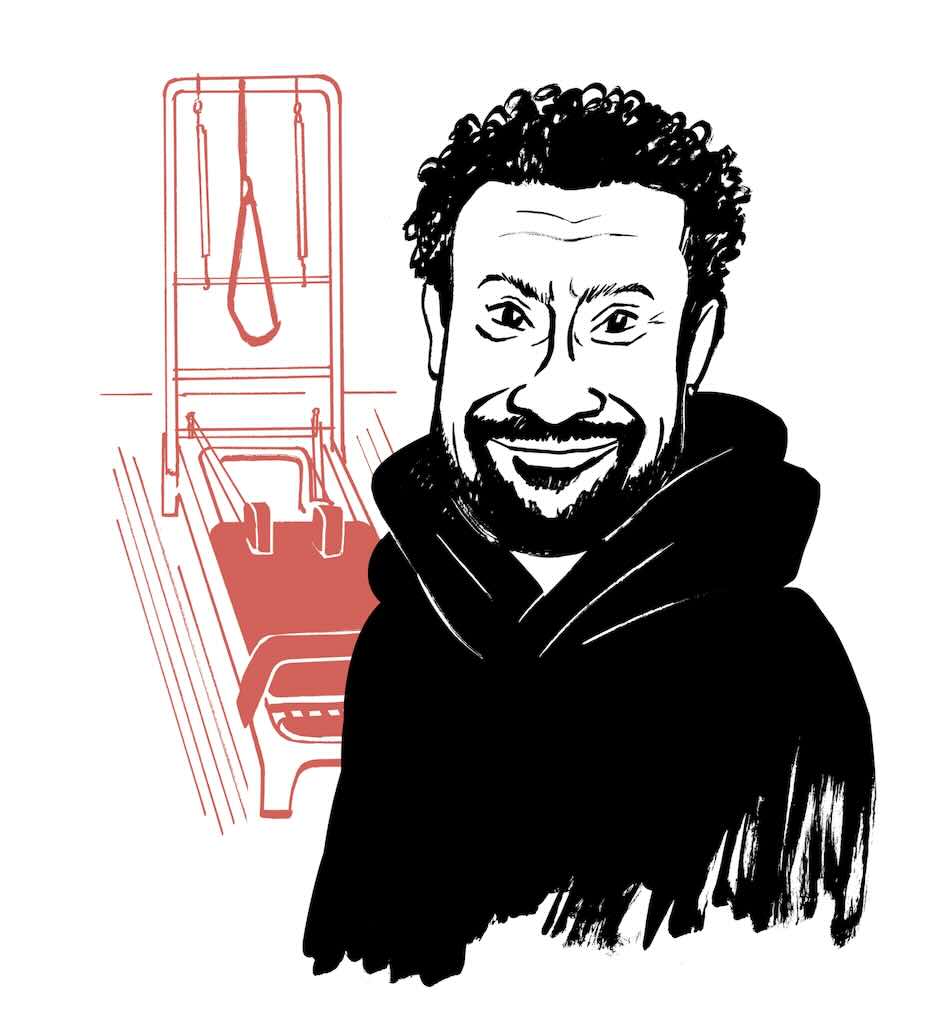
The star, who won a Grammy for Boombastic in 1996 and another with Sting in 2019 was on his way to another collaboration with Sting. At the beginning of the interview Shaggy, promoting his new album Lottery, is shaking all over and declaring “Jesus Christ!” while holding a Pilates ball between his knees and pumping his arms up and down.
He is handed a pair of grippy socks and put on a Reformer, where he performs the Teaser “the most famous Pilates shape” by extending his legs to make a V with his torso. When Eisler says “that’s impressive” about his efforts he is delighted.
By the end of the session Shaggy has decided that Pilates is indeed Boombastic and fantastic and he is thinking about buying Reformers for his houses in Miami and Kingston. The piece ends with Shaggy warming down on the Reformer doing “Pilates running”, by alternately bending his knees and being asked to, “lift your legs and start to levitate”. How long until a Reformer appears in his next video?
Over the Moon
We’ve always thought Pilates is out of this world but now it’s been linked to Nasa’s recent Artemis II trip around the Moon. “Why we need to work out like astronauts,” is the title of an intriguing feature in the Times. Nick Caplan, a professor of aerospace medicine and rehabilitation at Northumbria University, where research for the European Space Agency (ESA) is done, tells the paper that the changes astronauts experience are equivalent to accelerated ageing on Earth. He suggests that we could all benefit from training like the Artemis II crew upon their return.
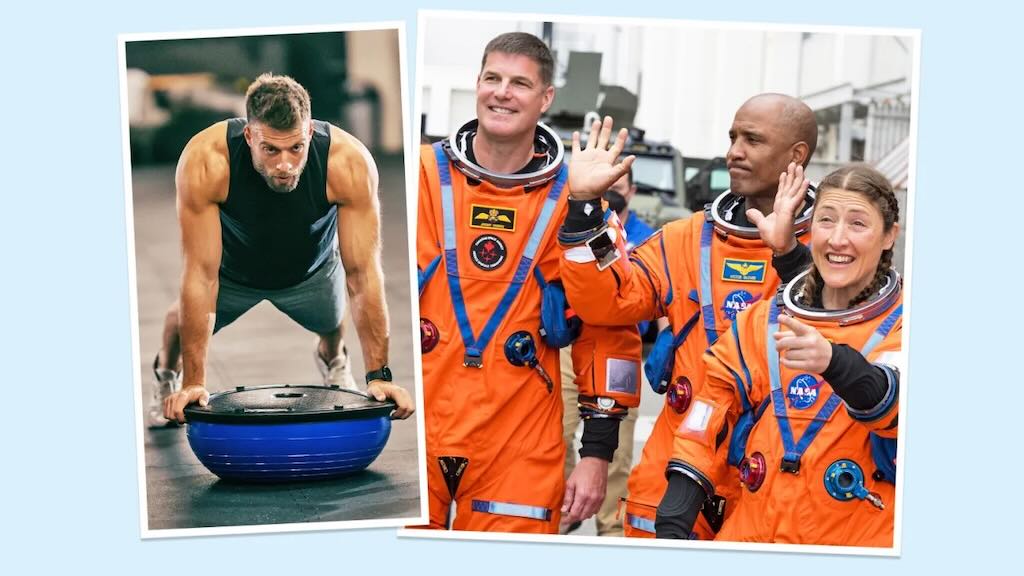
Living in the low gravity of space weakens muscles in the limbs, back and neck, shrinks bones and affects balance. Caplan’s tips for astronaut rehab include standing on one leg, jumping, using wobble cushions and vibration platforms and doing Pilates twice a week to target your ‘forgotten’ core.
Caplan tells the Times: “Astronauts are constantly pulling themselves around in space so their upper limbs do retain strength. But the muscles around the pelvis and spine are not worked in space and reduce rapidly at a rate of two to three per cent per week… Pilates, particularly on a Reformer machine, targets the deep stabilising muscles of the spine and hips that conventional exercise tends to miss. These are the very same muscles that floating in microgravity and sitting in chairs effectively switches off.”
Space flight can produce similar symptoms to those on Earth who spend too much time sitting or being inactive, notably bad backs and poor posture. The solution it seems is to boldly go to a Pilates class.
Alpaca Pilates
Anyone wanting to work on their six-alpaca should surely head to Dorset where alpaca Pilates is a thing. The Dorset Echo reports that Hot Pilates is running alpaca classes at Hope Farm in Corfe Mullen, led by teacher Jessica Hole. Jessica explains: “The animals are free to roam around while we practise, and often want to say hello and become part of the class. They have different personalities, some of them are more shy and like to watch from a distance. The more eccentric characters like to clamber onto the mat with you, roll around next to us, and come and explore what’s going on.”
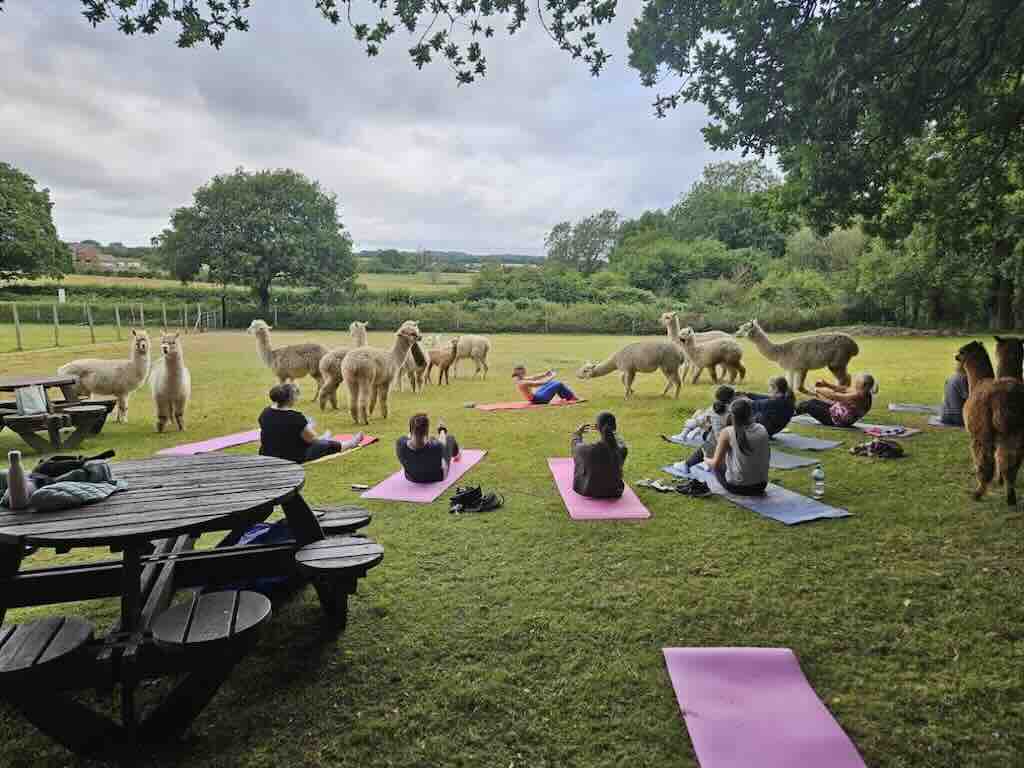
The mat classes are suitable for all furry and non-furry clients and alpaca in a lot of work. While Pilates Central is remaining animal free for the time being the classes do sound a lot of fun. At the end the herds of humans are allowed to feed the by now very well-aligned alpacas. Jessica Hole continues: “Last year there was a little baby that liked to nibble at my hair whilst I taught; it was adorable. There is a really big alpaca who likes to plonk himself right in front of me while I teach and watch everyone, like he’s checking everyone’s form and technique. They will make you giggle.”
If you would like our newsletter you can subscribe on the Home page. Follow us on social media:
Facebook | Instagram | X | Linkedin.
The Pilates Central Team