People often experience problems with their balance as they age. It’s common for older people’s health to decline after they suffer a fall, particularly if they suffer from osteoporosis and break bones. If you are having problems with balance then it is wise to check out factors such as blood pressure, heart health, eyesight, and inner ear problems. But if none of these are a problem then Pilates can certainly help with balance.
Pilates can be good for say tennis players who require balance while playing on one leg or footballers who want to glide past tackles but also for the elderly losing their coordination and, the evidence suggests, for those with neurological conditions like Parkinson’s Disease. Balance is about more than just standing on one leg, though this is a good test. You need balance for running and walking, walking up stairs or standing up from a chair without falling over.
The Sixth Sense
It can train your proprioception to be better. Proprioception is sometimes referred to as the sixth sense. It is how the body senses its position and movement in space. Receptors in your muscles, joints and tendons and even skin send messages to the brain — a kind of biological software that enables your body to know where your arms, legs, hands and feet are in relation to your body, to help you move smoothly and without falling.
As we get older that sense of spatial awareness involved with our balance and coordination can decline. Changes occur in muscle strength, nerves age and the body becomes slower at sending signals to the brain. Injuries can also affect our proprioception. The hunched posture typical of some people as they age can be the result of spine and trunk muscles weakening and losing their stability. Pilates aims to correct this.
Slow Movements
Working on the core will lead to stability in the body as a whole. Pilates will help to improve the muscles you need to give better coordination and balance. Joseph Pilates originally called his system contrology, and good balance is about controlling the position of your body. The slow movements will re-train the receptors in your muscles, joints and tendons resulting in improved habits and better reactions.
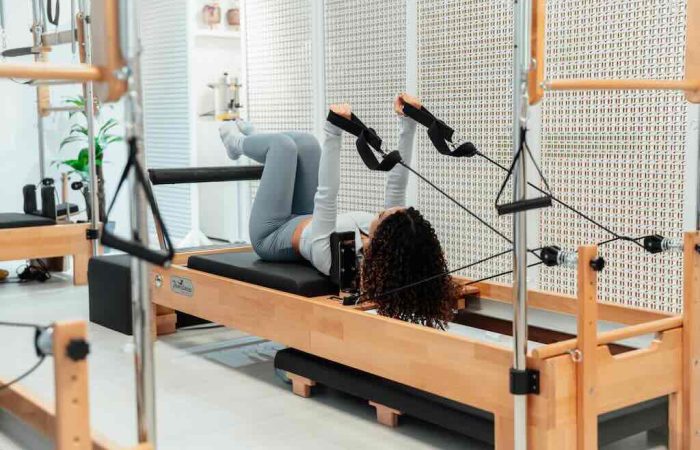
Your Pilates teacher will look at the quality of movement and alignment and control of the body, getting your limbs in right position so that they work effectively. They might test your ability to control your body while, say, standing on one leg. Strong muscles help control body movements and better lower limb strength leads to stronger ankles and less falls. The Reformer can work on all the smaller muscle groups vital to coordination and balance.
Many Pilates movements will challenge your balance, such as lunging on the chair or side splits on a Reformer. With mat Pilates bridges, quadruped exercises and squats can all help with balance.
Regular exercise will also improve all-round fitness and body awareness. Pilates can help with your confidence and ability to balance while doing everyday tasks. It will hopefully improve your life balance in every sense.
If you would like our newsletter you can subscribe on the Home page. Follow us on social media:
Facebook | Instagram | X | Linkedin.
The Pilates Central Team
[image credit: Andreea Boncota, unsplash.com)